Local News
Winkler Runner Kevin Harder sets new personal best at Chicago Marathon
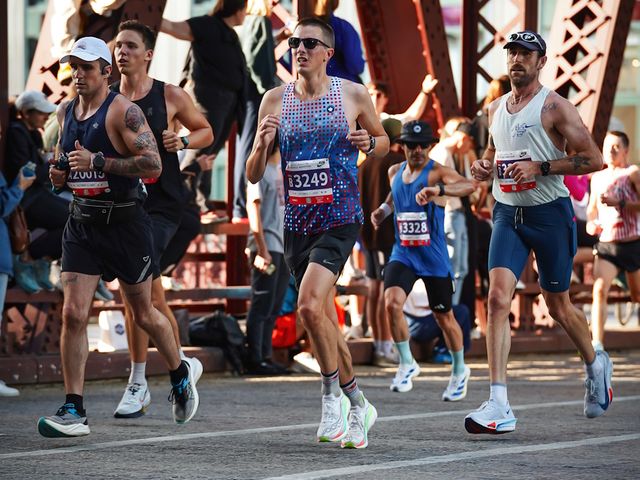
Winkler runner Kevin Harder returned from the Chicago Marathon with a new personal best, another major marathon medal and an even stronger desire to break the two-hour-and-50-minute mark. Harder crossed the finish line in two hours, 50 minutes and 58 seconds—71 seconds faster than the 2:52:09 he ran at the Boston Marathon. A Personal Best in Warm Conditions Although pleased to improve his time, Harder said he had hoped to finish in under 2:50. “I knocked off 71 seconds off my personal best in Boston,” Harder said. “It wasn’t quite the goal I was aiming for. I was trying to get under two hours and 50 minutes, but the temperatures kind of played into it. The conditions were a little warmer than ideal.” The race began at 7:30 a.m. with the temperature already at 16 C, and it continued climbing. Harder said his preferred temperature for a fast race is between five and 10 C. By mile 15, the heat and the effort had left him nauseated, but he kept pushing toward the finish. A Fast, Flat Course with a GPS Challenge Chicago’s flat route is known for fast times, but the city’s skyscrapers can interfere with GPS signals. Harder used his running watch for elapsed time and wore a paper-style wristband listing his target splits. “There are course markers every mile,” he explained. “I’ll just lap my watch to see what elapsed time I’m at and then compare with my wristband. It’s a good check every so often—am I on target here?” Harder earned guaranteed entry to Chicago because his Boston time met the standard for his age group. For many applicants, entry is decided through a lottery. Twenty-Nine Neighbourhoods and a Wall of Sound The marathon took roughly 55,000 runners through 29 Chicago neighbourhoods. Harder said the changing sights and sounds made the race feel like a tour of the city. “You’re going through all these neighbourhoods and you’re seeing demographic changes in the fans,” he said. “All of a sudden there’s a big Latino contingent and they’ve got the music going, and then you go into Chinatown, so you’ve got Chinese flags everywhere and everyone’s cheering.” Harder said organizers estimated about 1.7 million spectators came out to watch. He ran without music, preferring to stay focused and draw energy from the crowds. At several points, he heard spectators calling his name even though names were not printed on the race bibs. Later, while reviewing race photos, he discovered another runner nearby had “Kevin” written on masking tape. “I was sort of confused, but I was like, ‘I’ll take it,’” Harder said. From Chicago Pavement to Manitoba Trails Chicago was not Harder’s only recent test. He also completed the 50-kilometre Race to the North Face in the Brandon Hills, a trail event with far more climbing and uneven terrain than the flat Chicago course. “It’s totally different from Chicago in that it’s a trail race, so there’s a lot more up and down,” he said. Despite the rocks and hills, Harder described the course as runnable and suitable for a faster ultramarathon time. Related stories: Goal-oriented runner completes 110-kilometre ultra-marathon in 23 hours The Sub-2:50 Goal Still Calls Harder is taking some recovery time, but his next goals are already coming into view. He is considering another road race and expects another 100-kilometre trail race could be on his schedule next year. “The sub-two-hours-and-50-minutes is still nagging in the back of my mind,” he said. “I’m looking at another road race to see if I can nail that down, and then probably another 100-k trail race is going to be in the books again for next year.” He has also thought about stepping up to a 100-mile race, though he admitted the distance still scares him. Still Running Every Street at Home Even during recovery, Harder continues to run locally. Using Strava data viewed through CityStrides, he tracks which streets he has covered in Winkler. After new street segments dropped his completion percentage, he ran the missing sections and returned his city map to 100 per cent. For Harder, the local challenge offers another reason to keep exploring on foot. “It’s cool because I discovered a new one I’d never known about,” he said of finding a pathway in his hometown. “I’ve lived here all my life.” With files from Jayme Giesbrecht
























 Retail, Labour, Full-time, Permanent
 Featured




 Sat, Oct 24, 9:00 AM