





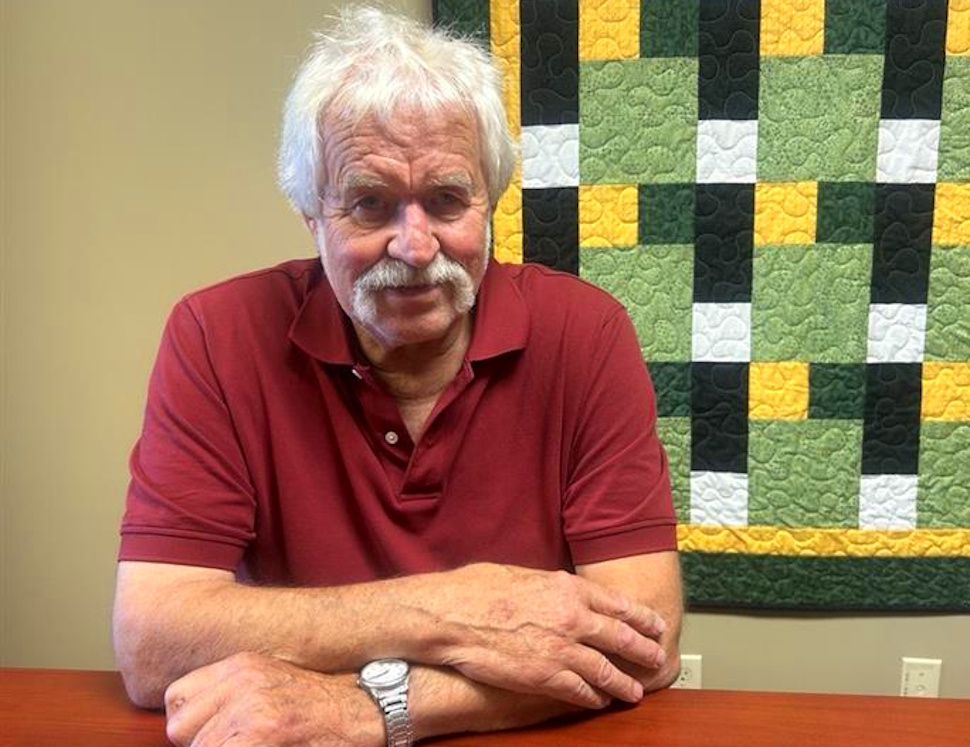
Ken Sawatzky says his roots in the Altona area, decades in business, and experience working with community organizations are all part of what he would bring to the reeve’s chair in the Municipality of Rhineland.
“I am born and raised in Altona area, Weidenfeld,” said Sawatzky. “I am a third generation on the yard we live on. It's been in our family for 110 years.”
Sawatzky said he started a house painting business in Winnipeg at age 23 before moving it to Horndean, then Altona, where it grew into commercial sandblasting and painting work and, finally, to his rural yard. He said that background gave him experience with construction, industrial contracting, safety requirements, inspectors, and working through complex projects.
Related stories:
- Rhineland Reeve, Ward 2 council elections set for October 28th
- Penner says local government offers chance to make a direct impact
Focus on community growth
One of his main priorities, if elected, would be helping Rhineland communities like Rosenfeld, Plum Coulee and Gretna grow. Sawatzky said Rosenfeld and Plum Coulee are currently out of residential lots, and he believes there is interest from people who want to live in the municipality.
Sawatzky said any expansion would require discussions around infrastructure, including septic or sewer systems and water service.
Drainage considerations
He also pointed to drainage as an ongoing issue in the municipality, saying while flooding cannot be stopped entirely, he would like to look for ways to help water move more quickly through farmland.
"That'll never end. So, the only thing I can do is see if we can somehow work it that when the water comes down, and I'm in the creek, my land floods out to where I have pasture, I know what it's all about. If we can somehow get it just to move quicker. We can't stop it. It's a natural flow of the water, but maybe we can figure out something to make it flow through the farmer's land a little quicker."
Road safety concerns
Sawatzky said he would also like to work with Manitoba Transportation and Infrastructure on the stretch of Highway 30 from the Buffalo Mills area and Elmer’s Manufacturing toward Altona, where he says traffic can build up at the end of the workday.
“We're looking for an accident to happen there,” said Sawatzky. “There are too many people coming onto the highway at 3:30 p.m.”
He said possible solutions could include a turning lane, shoulder changes, or a frontage road, though any changes would need to involve Manitoba Highways.
Recreation cost-sharing
Sawatzky also believes Rhineland should contribute toward recreation facilities in Altona that are used by rural residents, such as the aquatic park, baseball diamonds, skate park, walking paths, and hockey facilities.
"Let's say rural and Altona kids playing hockey, just for one thing. If we look at the percentage, is it 30% rural kids in there? We should be (contributing) whatever expenses are incurred," he said. "The aquatic park, the baseball diamonds and all that kind of stuff, building that new baseball diamond cost a lot of money. I know it was done by donations, but there's ongoing things that the town I'm sure has to absorb. So, I would go on a percentage. We can figure that out easy enough. When kids register, we know exactly how many rural and how many town kids there are."
Why he says voters should support him
Asked why voters should support him, Sawatzky said he has time to commit to the job as he slows down his sandblasting and painting business, along with experience dealing with a range of situations.
"I've worked with the pipeline for 42 years doing their tanks and I specialize in height work [...] underground stuff. So, I have construction experience. I'm used to dealing with safety inspectors. I'm used to dealing with contract inspectors, all the issues that come along with industrial work. So, I bring experience of dealing with people."
He's also served as President for Altona Minor Hockey and Pembina Valley Bible Camp.
"When I was president of minor hockey, you're dealing with countless parents. Pembina Valley Bible Camp, you're not dealing with parents so much, but you're dealing with kids and facilities."
This led to experience in fund raising, as well.
"We built that dining hall," explained Sawatzky, citing the large-scale project at the Bible camp. "It was a $300,000 dining hall, and I told my board, 'We can't go out to the churches and other places to raise money unless we as a committee donate 10%. So, we had to all pledge up to 10%, which was $30,000, and then we could go out and raise the money. And we did, but we were the example. So, I believe in leading by example."
Sawatzky also described his approach to bringing ideas forward. And while he admits not every idea will move forward, he believes it is better to think big and adjust than to start too small.













 Fri, Oct 2, 9:30 AM


 Full-time, Permanent, Salary, Agriculture, Manufacturing, Professionals, Transport
 Featured